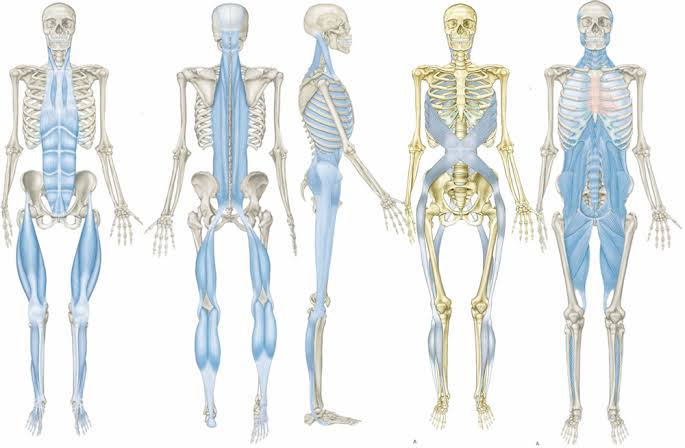
Everything’s connected
Change one thing, change everything
Have you or do you know someone who has ever suffered from sciatica? The symptom is a tingling/numbing/weakness and or electric pain, down the side of the leg, sometimes right into the foot. It can often take years to resolve.
Or you might have sprained a muscle in your lower back, which healed up quickly but you were left with pain down the front of your hip into your thigh.
The point of this is that sometimes, where we have the problem isn’t necessarily where we feel it.
And the reason is that everything is connected to everything else in our body via our fascia.
This is the dense web of connective tissue that fills every space in your body. It’s under your skin, round every organ, and connects and separates muscles from each other.
Neural fascia surrounds every nerve. So pinching of the fascia round the femoral nerve on the right side of the lower back can cause pain in the front of the eft thigh.
Dural fascia surrounds your brain and spinal cord, running from your skull to your tailbone where it becomes continuous with the fascia of your pelvic floor.
This can be why when your shoulders are tense, the shortening of the small muscles around your shoulders and neck, which are connected to and continuous with the dural fascia, can lead to you getting a headache.
The anatomy “trains” model
Research is starting to find that the model put forward by Thomas Myers of anatomy “trains” – long distant chains through which force travels throughout the body – is correct (see the image at the top of the email)
Meaning, pull on one part of the chain and the rest responds.
For example, a 2017 study tested whether stretching the leg would improve neck range of motion via the fascial back line.
They split the participants into three groups: one group stretched the hamstrings and calves, one group stretched the neck directly, and a control group did nothing.
Both stretching groups improved range of motion in the neck compared to the control. The two stretching protocols produced similar results 🤯.
How can you take good care of your fascial train?
1. Stay hydrated. Fascia is approx 60-70% water held in a structured form by hyaluronic acid (HA), that binds water and forms a viscous, slippery gel. It’s this gel that allows the fascia to glide smoothly over each other.
When they don’t glide smoothly and become denser it’s one of the biggest reasons for stiffness and chronic musculoskeletal pain.
2. Move in as many different directions as possible as often as possible. When you sit in the same position for hours, the HA becomes gluey, and the tissue stops sliding well. This is why you don’t move well first thing in the morning being immobile all night; and why your back feels tight after eight hours at a desk!
And there’s a longer term outcome: a body that doesn’t move through full ranges of motion (ROM) regularly, will progressively find its fascia gets denser over months and years, reducing ROM further.
Want to get some good quality movement in that takes your fascia through lots of ROM and directions? Easy, start one of my beginner level Pilates classes!
Ideal classes are Monday 1040, Tuesday 5pm (from September) or Wednesday 9.10am. (just one space left).
See you on the mat,
Tracy